Pomp and Circumstance
Pennsylvania Avenue, Washington, D.C. 2026
Background
General John J. Pershing commanded the American Expeditionary Forces on the Western Front. Robert White sculpted the figure, which was dedicated in October 1983 as eight feet of bronze on a Dakota mahogany granite pedestal. The memorial's walls and inscriptions detail his leadership in the First United States Army, the Meuse-Argonne Offensive, and the signing of the armistice with Germany, alongside his own tribute to the officers and men of the American Expeditionary Forces: "In their devotion, their valor, and in the loyal fulfillment of their obligations, the officers and men of the American Expeditionary Forces have left a heritage of which those who follow may ever be proud."
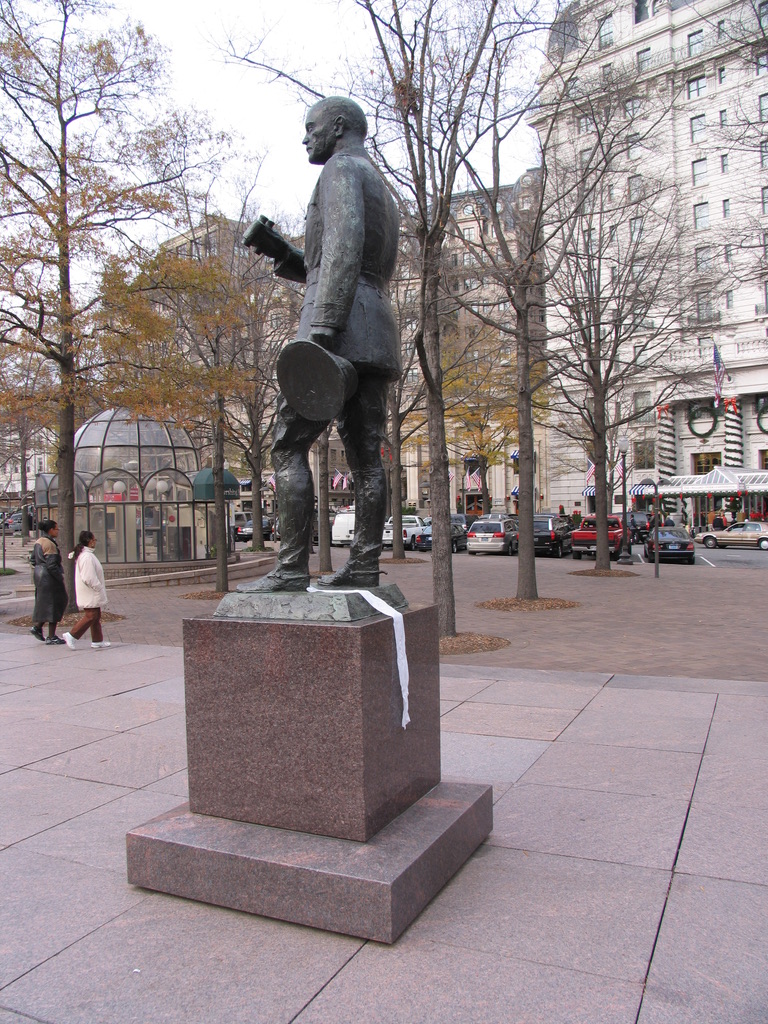
Ironically, the wall does not say that Pershing was the first chairman of the American Battle Monuments Commission, from 1923 until his death in 1948. The man who administered the oversight of these bronzes became the bronze. I decided to make Pomp and Circumstance by placing a strip of toilet paper under his foot. The idea was not to insult him, but to subvert the eight-foot bronze for what it is, a false illusion of grandeur. That is true of bronze war memorials. It is especially true of him because he chaired the commission that oversaw them, and that commission was later told to build this one.
Installation
The end of the strip was tucked under the heel and sole of his right bronze boot. The action required minimal effort and left the statue unaltered.
Lens
While the hack alters a civic structure it is not modifying like a flower-sign. It is a commentary more appropriately marking it as debris that should be removed. This classifies it as Stain.
Conclusion
The installation succeeds on impact versus effort. It subverts the statue's grandeur. It did not state what is not on the inscription, that he chaired the American Battle Monuments Commission, the independent federal agency later charged with the memorial. Had he not chaired it, this statue is less likely to exist. The commission paid $400,000 for the park. The water failed. The Park Service could not keep the pond or the rink running. The answer was a larger memorial. The statue and the wall were kept. Sabin Howard’s bronze, A Soldier’s Journey, and a new fountain were added, on a bill in the tens of millions.
Glossary
The full list of terms is on the glossary page. Words used in this study:
Civic structure. A repeating object the city maintains so the vein can run. A stop sign, a meter, a bronze set in a park. Working or not, it is the city's object.
Debris. What sits in the walking space and gives nothing back. A dumped mattress, a cart, a bronze that performs no duty. Stain marks it. Flush does not.
Flower-sign. A stop sign hacked with a flower and left in service. The command still stops the cell. The change is medication, not a mark on waste.
Medication. A change to civic infrastructure that leaves the object in use. A stop sign still stops. This bronze performs no function. The paper is not that treatment.
Stain. A mark on an object already sitting in the walking space. Gold on uncollected trash, words on a mattress, a string of toilet paper on a shoe.
Full Glossary >>
More Case Studies >>