Out of Season
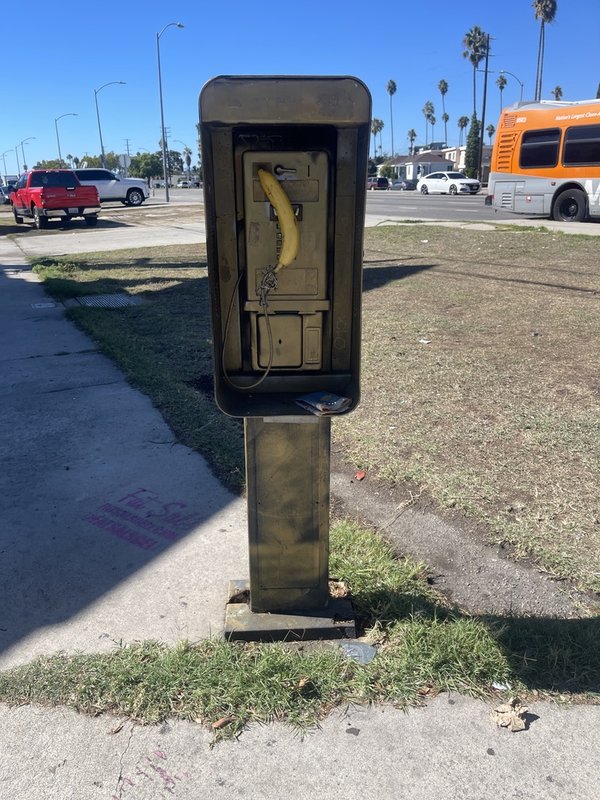
La Brea Avenue, Los Angeles, 2025
Background
At its peak in the late 1990s, California had 277,000 payphones. The working number in the state today is 2,525, according to the California Public Utilities Commission. The problem is that many of the non-working ones remain. They technically belong to whoever still holds the permit, usually a carrier or a small operator. Removing a dead booth costs a truck and a permit. Leaving it costs nothing. Adding a banana where the phone should be is the same joke people used, holding a banana to the ear and pretending to take a call, because the fruit was curved like the old receiver. The irony is that the joke is also deprecated. The receiver, the switchboard operator, the telegraph, moved onward into the past.
Installation
The banana was set in the booth at La Brea and Venice, where the receiver would have been. The housing was left as it stood.
Lens
This one is more difficult under the lens, but the best classification here is flush. A phone booth is a civic object the city repeats. Some in Los Angeles still take a call. This one does not. Left on the corner, it looks like a service and is not one. That is an eyesore that misleads. If you pulled the booth and set it in a gallery, the room would call it art. If the banana were plastic and stayed, the addition could be read as a sculpture on a civic structure, which is the medication reading, the same move as a stop sign turned into a flower-sign. The flowers make it a sculpture without taking the job away. It could still be classified as nutrition, but ultimately I still go with flush. The booth is not an isolated case. The working count is 149 in Los Angeles, but dead ones can still be found all over the city and should be removed.
Conclusion
Out of Season is the booth, not the produce. The produce was gone a few days later. Maybe someone ate it. The booth still stands. I could probably go out with an angle grinder in the middle of the day and take it down. Unlike all of the shopping baskets strewn over LA, a metal collector would probably be able to take the phone and get money out of it. Maybe not. That the permit is held by a private citizen doesn't excuse the city from leaving the debris. It's simply another case where the broken system prevails.

Glossary
The full list of terms is on the glossary page. Words used in this study:
Broken system. The city leaving debris because removal costs a truck, or because a permit is held by someone else.
Civic structure. A repeated object the city puts in the walking space. A phone booth. A stop sign.
Debris. Bulk in the walking space that no longer does its job. A dead booth.
Flower-sign. A stop sign hacked with flowers. The sign still stops. The flowers make it a sculpture.
Flush. The larger reading on civic blockages in the walking space. The banana marks a booth that no longer takes a call.
Medication. A change to a civic structure that leaves the object in use. A plastic banana that stayed could be read this way. This booth does not work.
Metal collector. Metal collectors in Los Angeles—often called scrappers—are individuals or independent operators who gather, sort, and deliver discarded metal items to local recycling centers and scrap yards for cash.
Nutrition. Public work that asks nothing and sells nothing. A sculpture reading of the banana could be filed here. The fruit rots.
Full Glossary >>
More Case Studies >>